Flux Working Papers
A citable, timestamped registry of the series. Each paper has a stable number, a content fingerprint, and — once deposited — a DOI.
- Papers
- 43
- Sectors
- 6
- Figured
- 38/43
- Deposited
- 0/43
- Span
- Jan – Oct 2026
- Reading
- 1030 min
| No. | Title | Sector | Published | Identifier | Fingerprint | Details |
|---|---|---|---|---|---|---|
| WP43 | Système D as Infrastructure: Nineteen Nairobi Workarounds and the Research That Already Explains Them | Civic & Democratic Infrastructure | ⌁ verified |
823057d644d4
|
||
|
When formal infrastructure doesn't reliably show up, people build around the gap, informally, and get very good at it — good enough that the workaround itself becomes a durable, teachable skill, passed down without ever being written as a workaround. This is not a Kenyan phenomenon. It has at least three independent names in three literatures that rarely cite each other: jugaad in Indian innovation economics, Système D (from débrouillardise) …
|
||||||
| WP42 | Only the Date Is Settled the only fact about Kenya's 2027 election that is currently beyond dispute is the date — 10 August 2027, gazetted in August 2026. The commission that will run it had no commission… | Civic & Democratic Infrastructure | ⌁ verified |
b6af8b6cacbb
|
||
|
This paper assesses, as of October 2026, what is verifiably settled, contested, or unknown about Kenya's institutional readiness for the 2027 general election, not who will win it. It finds exactly one fact beyond dispute: a gazetted election date of 10 August 2027. Every other dimension examined is currently unresolved. The Independent Electoral and Boundaries Commission operated without any commissioners for roughly thirty months, January 2023 to July 2025, a …
|
||||||
| WP41 | The Word "Personalized" Is Doing Two Different Jobs most of what skincare calls "personalized" just sorts you by skin type and price — it doesn't know or care that darker skin scars differently when things go wrong. The specific pe… | AI Automation | ⌁ verified |
72b902708ee3
|
||
|
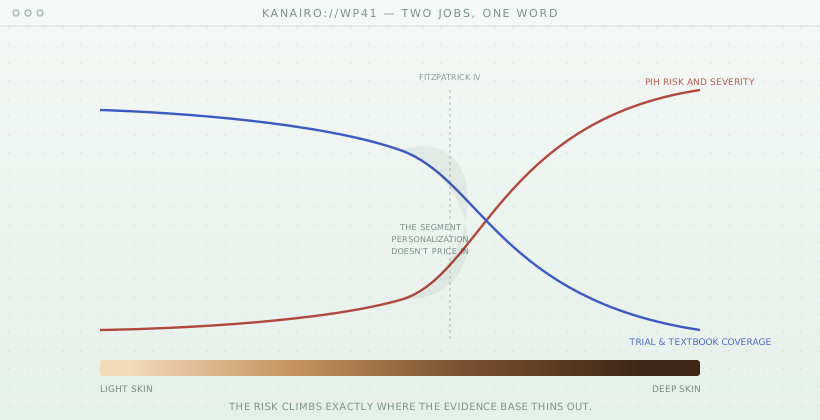
Skincare has sold "personalization" for a decade — quizzes, skin-type sliders, AI-matched routines — and most of what it delivers is cosmetic segmentation: oily or dry, budget tier, fragrance preference. Almost none of it is the specific personalization that melanin-rich skin actually needs, which is a routine matched against a documented, disproportionate risk: post-inflammatory hyperpigmentation (PIH), a complication that is measurably more common, more severe, and slower to resolve in …
|
||||||
| WP40 | Stage Three of Eight The Nairobi twin series we have spent five papers proving KaNairo is a good, honestly-labeled, increasingly well-measured 3D model of Nairobi. This paper checks that against what the rest of the world th… | Civic & Democratic Infrastructure | ⌁ verified |
a51b132ee7c8
|
||
|
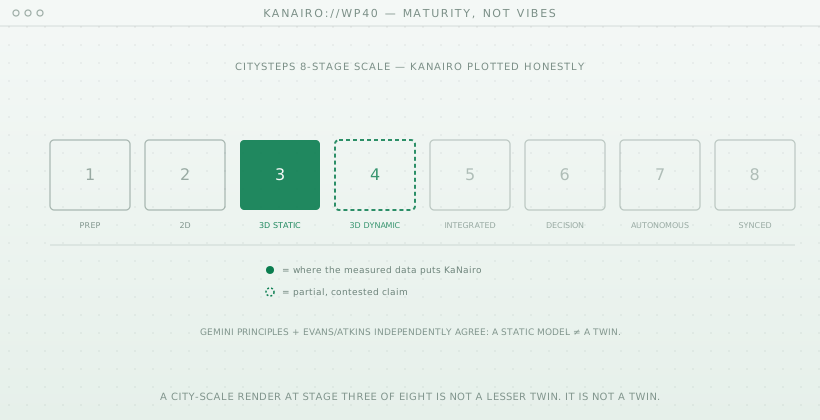
Seven papers in this series documented, in public, what it took to build KaNairo: merging OpenStreetMap and Overture Maps building footprints, moving satellite-measured heights from 0.3% to 73.6% coverage, tiling 1.27 million buildings for city-scale delivery, and — most recently — designing a provenance model for the day residents can edit the record. None of those papers asked whether any of this adds up to a digital twin by a …
|
||||||
| WP39 | The Switching Cost Is Why Nothing Sticks [[the-personal-operating-layer|the last paper]] said the useful AI would live in your messages instead of in an app you have to remember to open. This paper asks why that actually… | AI Automation | ⌁ verified |
7e89267c650e
|
||
|
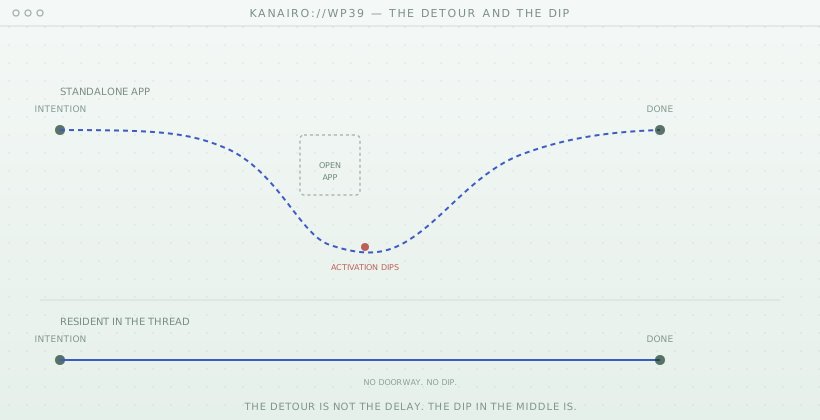
The Personal Operating Layer (WP26) argued that the most useful personal AI will not be an app people remember to open, but a presence already resident in their messages. That paper established the observation — people already run their lives inside chat threads — without establishing the mechanism: why does living in the thread actually outperform living in a separate app, rather than merely feel more convenient? This paper argues …
|
||||||
| WP38 | The Chargeback Assumes a Human The procurement trust series three papers in this series describe what changes when software does the buying. None asks what happens when the software buys the wrong thing. Stopping a bad purchase now happens… | Open Finance & Inclusion | ⌁ verified |
1ec8c941e57d
|
||
|
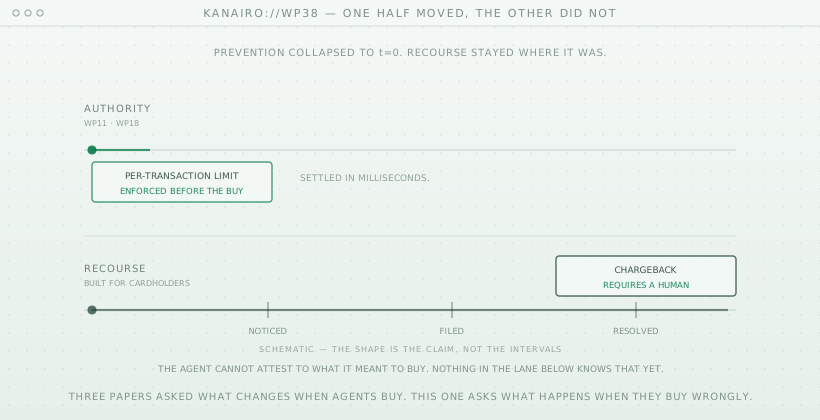
The Flux procurement trust series argues across three papers that spending control is migrating from after a purchase to before it. Each assumes the purchase succeeds. This paper examines the failure case and argues that prevention has collapsed to the instant of payment while recourse has not moved, because the dispute mechanism is evidentiary rather than financial and is built around a participant the transaction no longer contains. The gap …
|
||||||
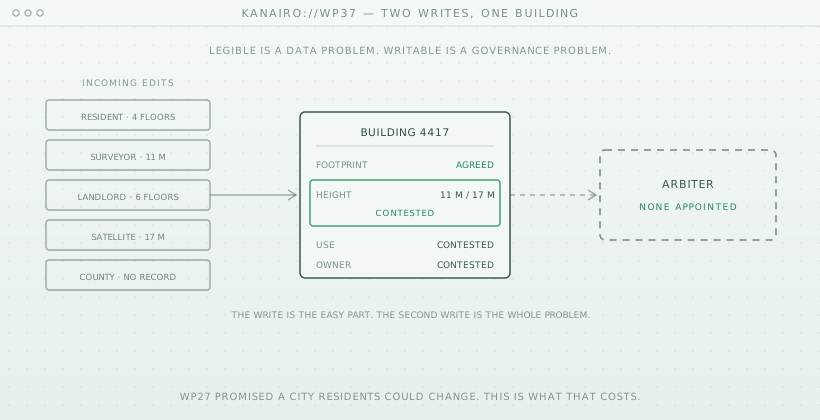
| WP37 | Who Gets to Say It's There The Nairobi twin series this series promised a Nairobi that residents could change, not just look at, and then spent six papers on measuring it. Letting someone write to the model turns out to be the eas… | Civic & Democratic Infrastructure | ⌁ verified |
c85ab20c14f2
|
||
|
The Flux Nairobi twin series opens by promising a city model residents can change rather than merely view, and its most recent paper is titled 'Legible, Navigable, Writable'. Both deliver only legibility. This paper argues that the write operation is trivial and that everything difficult about a writable city begins with the second, conflicting write — and that the choice of how to resolve it is a governance commitment the …
|
||||||
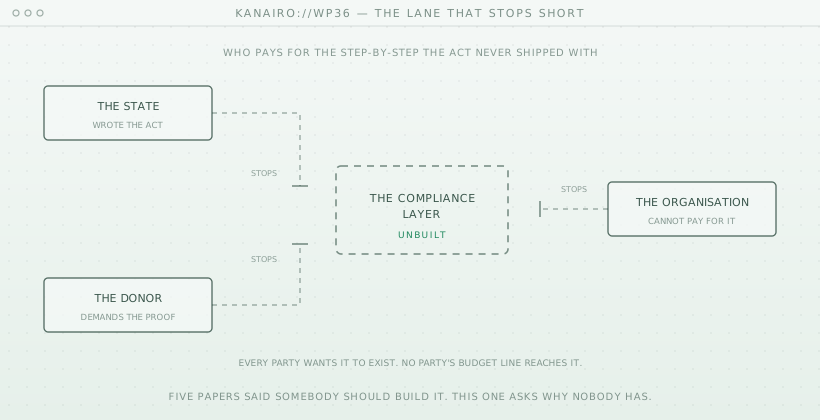
| WP36 | The Layer Nobody Is Paid to Build The PBO compliance series five papers in this series have ended by saying somebody should build the layer that turns the PBO Act into steps an ordinary organisation can follow. This one asks why nobody has… | Civic & Democratic Infrastructure | ⌁ verified |
2bda6e2f9899
|
||
|
Five papers in the Flux PBO compliance series conclude that Kenya's Public Benefit Organisations Act requires an implementation layer — something that converts statutory requirements into an ordered procedure an unadvised organisation can follow, as tax software converts the tax code into questions. None asks why that layer does not exist. This paper argues the omission is structural rather than technical: no party's budget reaches the layer, and the three …
|
||||||
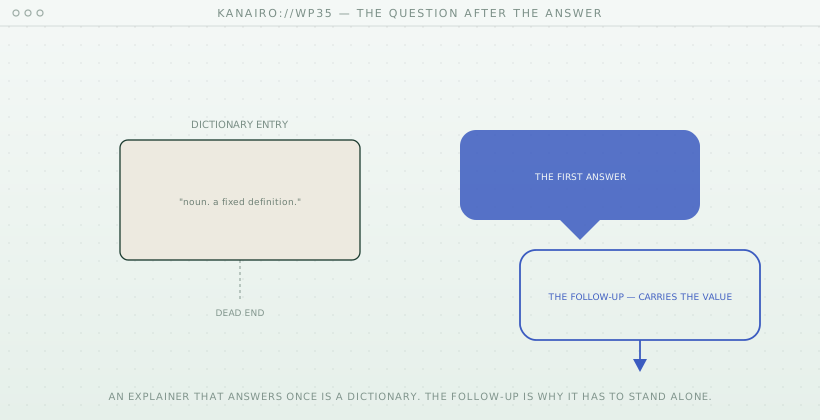
| WP35 | The Second Question: What Changes When an Explainer Can Be Asked Again an explainer that answers once is a dictionary. What makes it worth having is being able to ask the obvious follow-up in the same place, without starting over — and that single re… | AI Automation | ⌁ verified |
ad255d4a5951
|
||
|
This is a first-person design account of building an in-place AI explainer, using it for months as a browser extension and as a local desktop application, and discovering that its defining feature was not the one it shipped with. A single-shot inline explanation resolves a word but rarely the confusion: the first answer raises the question actually worth asking, and a tool that cannot take that question sends users to …
|
||||||
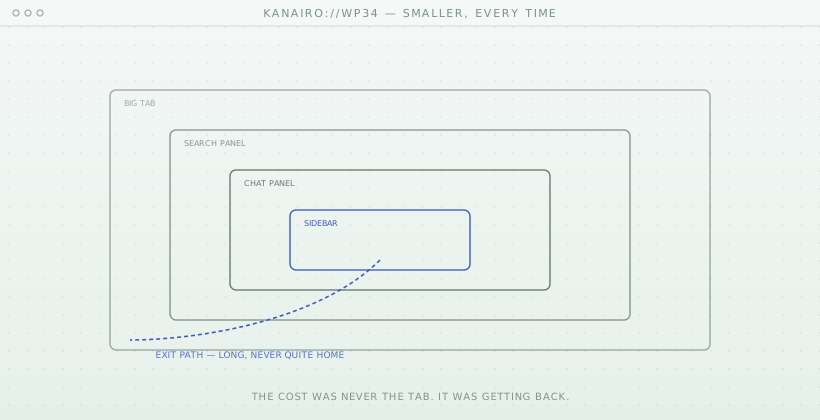
| WP34 | The Panel Is Also a Tab every tool that promises to explain a word without sending you away still moves you — into a panel, an overlay, a results page. The expensive part of looking something up was neve… | AI Automation | ⌁ verified |
ffc491896bf0
|
||
|
Mainstream AI answer surfaces converge on a single strategy for the mid-document lookup: bring the answer closer. Docked panels open beside the text, launcher overlays float above it, and search results increasingly compose the answer in place of an index. This paper argues that the first two solve the wrong half of the problem. The cost of interrupting a reading task to look something up is not the distance travelled …
|
||||||
| WP33 | What Dies on Election Night a Kenyan campaign is the most operationally capable organisation most constituencies will ever have. It is assembled from nothing in about six months, and it is dissolved at the e… | Civic & Democratic Infrastructure | ⌁ verified |
6fab0fbed7c8
|
||
|
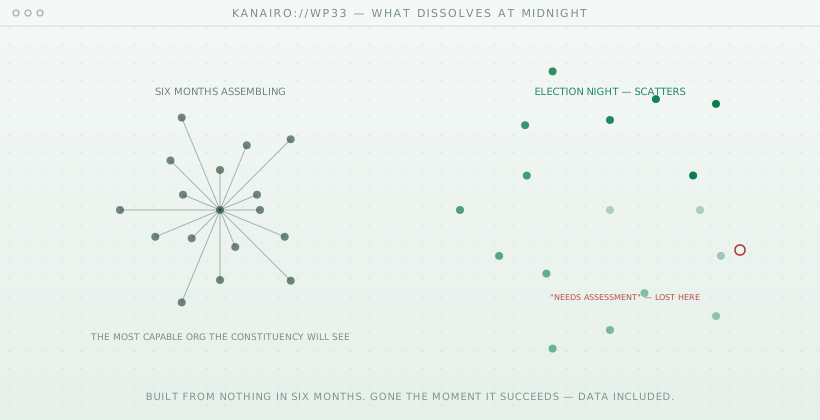
This paper argues that the periodic dissolution of electoral campaign organisations constitutes the principal source of institutional amnesia in Kenyan constituency governance. A competitive campaign for a parliamentary seat assembles, within roughly two quarters and typically from no prior institutional base, an operational capability exceeding that of the constituency office which succeeds it: sub-location-level field coverage spread across up to 1,450 wards in 290 constituencies, volunteer rosters in the hundreds, …
|
||||||
| WP32 | Legible, Navigable, Writable: What Measuring a City Actually Costs The Nairobi twin series we replaced guessed building heights with heights measured from satellite imagery across Nairobi, for free, using data someone else already published. It worked. It also revealed … | Civic & Democratic Infrastructure | ⌁ verified |
d150a3d0688c
|
||
|
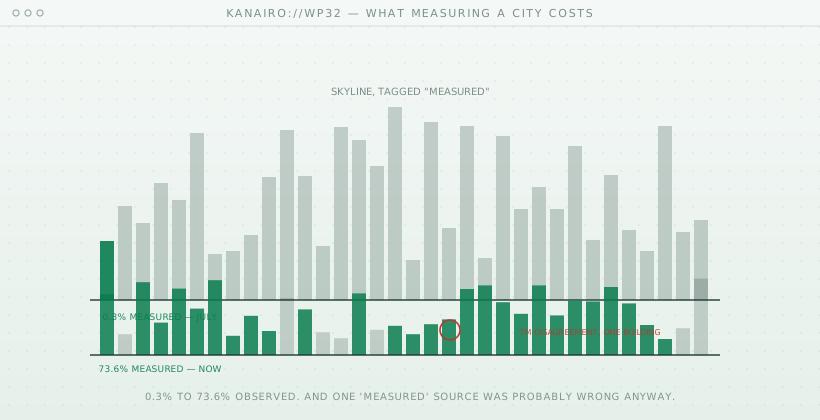
This paper reports two results. The first is a quantitative result from the Nairobi digital twin programme: replacing heuristic building heights with heights measured from satellite imagery, using Google's Open Buildings 2.5D Temporal dataset sampled inside each building's real footprint polygon, raised the proportion of buildings whose height derives from observation rather than inference from 0.3% (4,231 surveyed buildings) to 73.6% (1,014,865 of 1,384,206), achieved with a pipeline that reads …
|
||||||
| WP31 | Building Nairobi a Second Time: Notes From a Week of Shipping the Twin The Nairobi twin series a week-by-week account of how the Nairobi model went from about a thousand city-centre buildings to 1.27 million real ones across the whole metro — with the dead ends left in, and… | Civic & Democratic Infrastructure | ⌁ verified |
be46323dc7b8
|
||
|
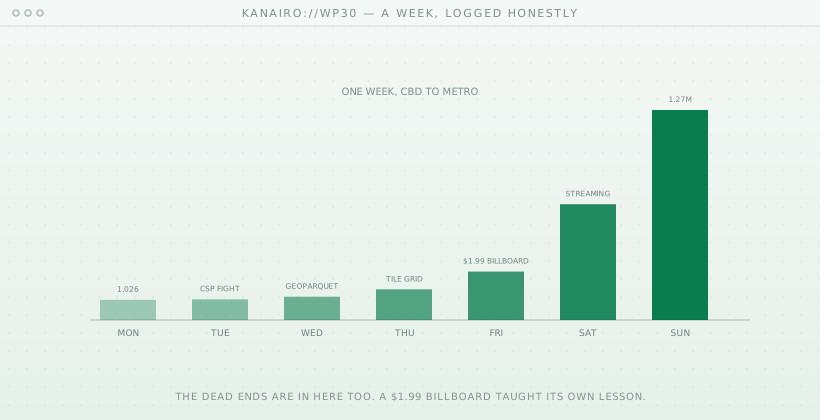
This is the first-person process companion to three technical papers on the Nairobi digital-twin buildings pipeline: a contemporaneous account of the week KaNairo went from roughly 1,000 central-business-district buildings to 1,277,511 across the full metropolitan area. It records the sequence as it happened — a Content-Security-Policy block, duplicate SSL-certificate failures, an Overpass API rejection resolved by identifying the requester, and the one genuinely easy step: the data itself, served free …
|
||||||
| WP30 | Estimating What We Don't Know: A Confidence-Tiered Height Heuristic for Data-Sparse Cities The Nairobi twin series we know where 1.27 million buildings *are*, but for 99.7% of them nobody has ever recorded how *tall* they are. Rather than guess silently or ship a flat city, we estimated every … | Civic & Democratic Infrastructure | ⌁ verified |
3d90192cf1ea
|
||
|
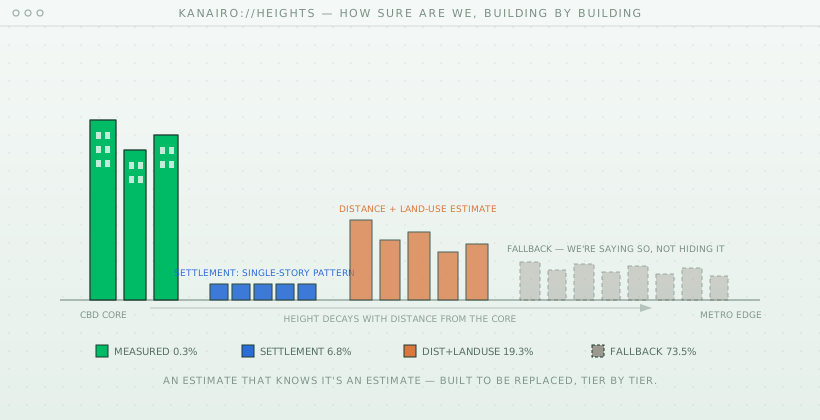
This paper documents a confidence-tiered heuristic built to estimate building height for the 99.7% of Nairobi's 1,277,511 buildings with no recorded height in Overture Maps, and reports the distribution produced (0.3% measured, 6.8% informal-settlement assumption, 19.3% distance-and-land-use estimate, 73.5% flat fallback). This revision adds a scope section separating the paper's reproducible claims from its more cautious ones, and reports a focused literature search into Tier H's own premise — that …
|
||||||
| WP29 | Who's Missing From the Map: Building-Footprint Coverage Gaps in Nairobi's Informal Settlements The Nairobi twin series every building on a modern open map got there one of two ways — a person traced it, or a computer spotted it in satellite imagery. This paper counts which was which, building by b… | Civic & Democratic Infrastructure | ⌁ verified |
cb324ea7f8d8
|
||
|
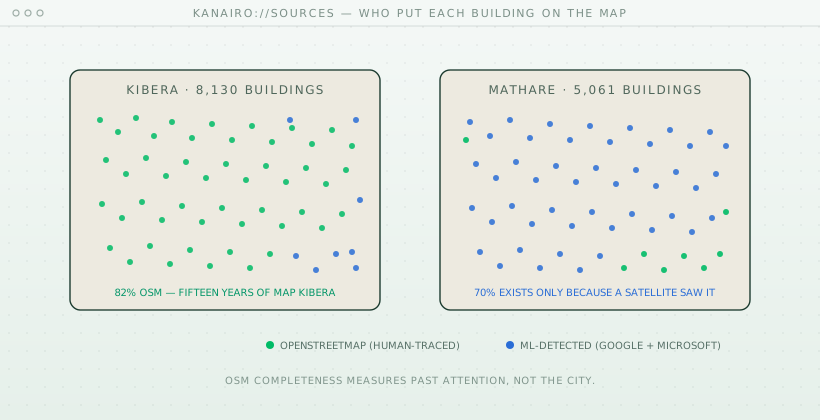
Prior research established that OpenStreetMap building-footprint completeness varies sharply across Nairobi, with one study noting Mathare had no building footprints in OpenStreetMap at all as of its writing. This paper checks that claim against current data and extends it to Kibera, decomposing Overture Maps' merged building layer by contributing source for both settlements: Kibera is 82.5% OpenStreetMap-sourced (6,706 of 8,130 buildings); Mathare is 15.7% (794 of 5,061), with Google Open …
|
||||||
| WP28 | From the CBD to All of Nairobi: A Tile-Streamed Building Pipeline for a City-Scale Twin The Nairobi twin series the old map showed about a thousand buildings in the city center. The new one shows every building in greater Nairobi — 1.27 million of them — and still loads fast, because it onl… | Civic & Democratic Infrastructure | ⌁ verified |
c2bb40ff37de
|
||
|
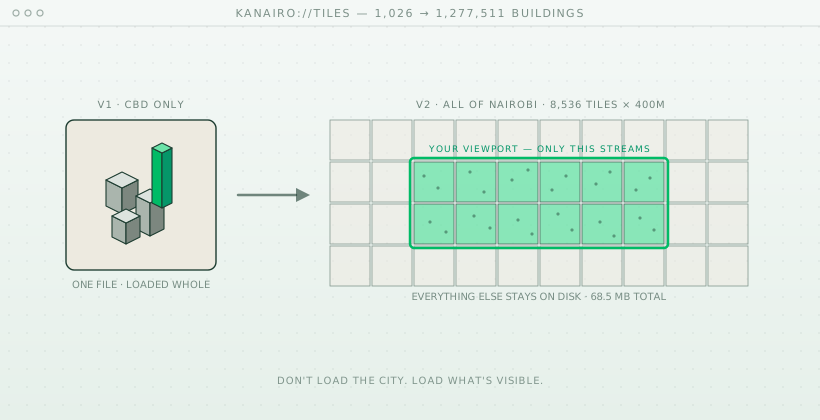
This paper documents extending Flux's Nairobi digital-twin render from roughly 1,000 buildings in the central business district to 1,277,511 buildings across the full metropolitan area, sourced from Overture Maps' merge of Google Open Buildings, Microsoft's ML Building Footprints, and OpenStreetMap, and streamed to the browser through a 400-meter tile grid (8,536 tiles, 68.5MB) rather than loaded as one file. This revision adds a scope section separating the paper's reproducible-pipeline claims …
|
||||||
| WP27 | The Twin Nairobi Doesn't Have Yet The Nairobi twin series we built a 3D model of central Nairobi you can explore, and sold $1.99 billboards inside it as a joke. The joke turns out to be a working prototype of the serious thing — a model … | Civic & Democratic Infrastructure | ⌁ verified |
2ba58d6ca215
|
||
|
"Digital twin" typically describes a 3D visualization exercise, yet the term originates from live-telemetry systems built to track one physical object's real condition, not from rendering fidelity. This paper argues a genuine 1:1 city twin needs two separate, so-far-unconnected halves. The first, institutional, is a live data-exchange layer between government systems, on the model of Estonia's X-Road — architected as a decentralized system after a 1996 data-consolidation scandal and now …
|
||||||
| WP26 | The Personal Operating Layer: The Case for an AI That Lives in Your Messages people already run their lives inside chat — texting themselves, keeping a group chat with exactly one member. The useful personal AI will not be another app you remember to open.… | AI Automation | ⌁ verified |
8a10b50be15f
|
||
|
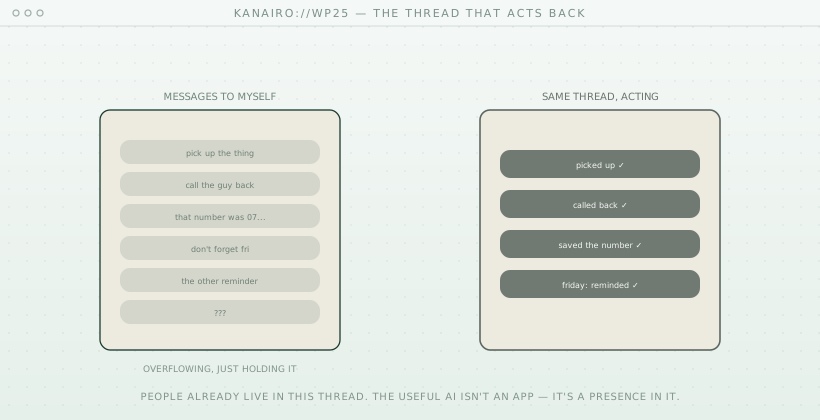
People already run their lives inside chat threads — texting themselves, keeping solo group chats as running records. This paper argues that the most useful personal AI will not be an application one opens but a presence in the message thread that talks like a friend, acts on the user's behalf, and holds them to their own goals. It frames this as the missing-layer thesis applied to an individual life.
|
||||||
| WP25 | The Operating Workforce: An African-First Theory of AI Employees "AI employee" normally means replacing somebody who has a job. In African institutions the roles are mostly unfilled to begin with — one procurement officer doing the work of a wh… | AI Automation | ⌁ verified |
c548f3d54fed
|
||
|
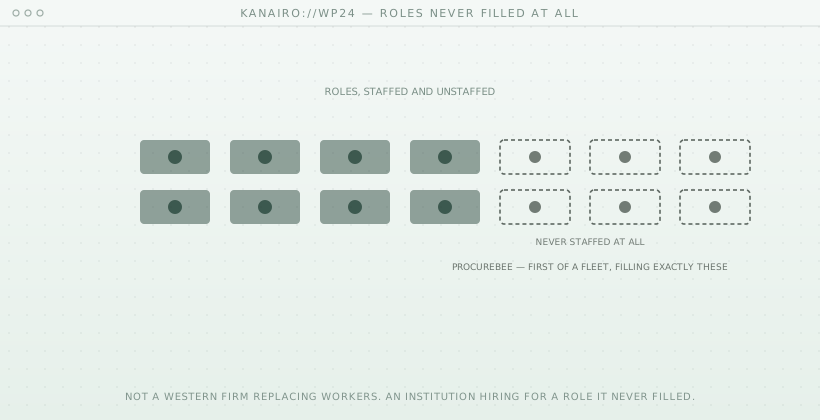
The phrase 'AI employee' typically evokes a Western firm replacing expensive knowledge workers. This paper argues the African case inverts that picture: AI employees will first fill roles institutions never managed to staff at all. Building on the missing-layer thesis, it develops an African-first theory of the operating workforce — role-scoped, accountable agents that do an institution's routine, rules-bound work — and presents procurement as the first such role.
|
||||||
| WP24 | Snakes And Ladders: Extra Life a placeholder note rather than the paper. It sets out what Snakes and Ladders actually is — a game of pure chance descended from an Indian morality game — and what an "extra life"… | Culture | ⌁ verified |
c1798ba4463b
|
||
|
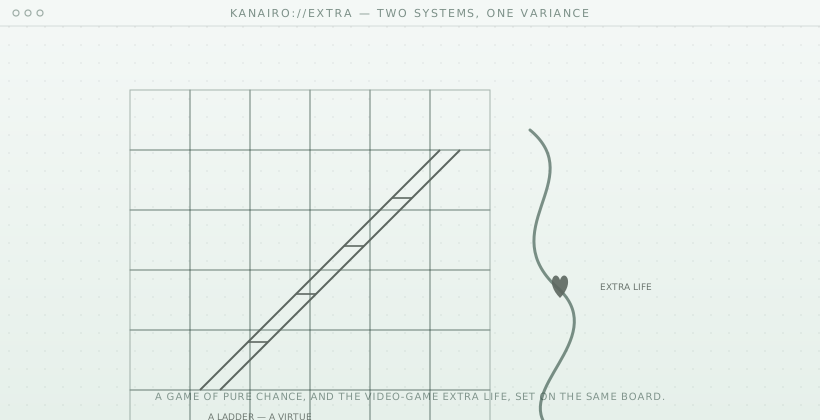
A note ahead of the paper: Snakes and Ladders is a game of pure chance, descended from an Indian morality game whose ladders were virtues and whose snakes were vices. The paper sets that board beside the video-game extra life. |
||||||
| WP23 | The Institutional Gap Is the Feature the standard view is that African institutions will get to AI late, because they have less of everything. This paper argues the opposite. Where you cannot simply hire another pers… | AI Automation | ⌁ verified |
900eabf5d20b
|
||
|
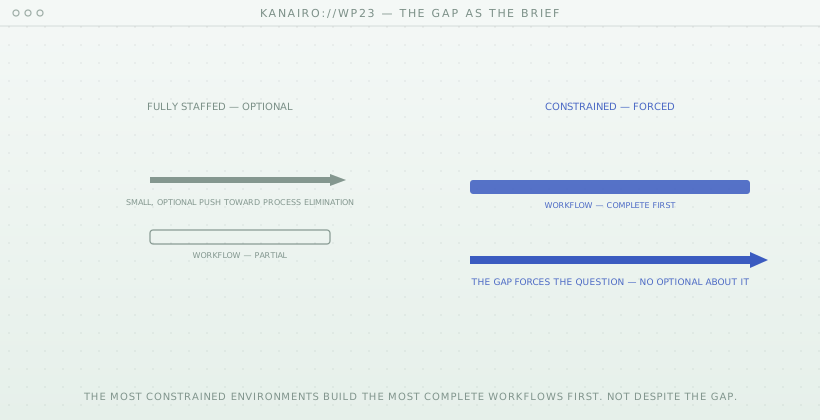
This paper argues that the most constrained environments are plausible — not proven — ground for AI-complete workflow design: where staffing a process is not financially viable, the choice is not between augmenting a process with AI and redesigning it, but between redesigning it and the process not happening at all. Well-resourced organisations retain the option to merely optimise an affordable existing process and, this paper argues, tend to exercise …
|
||||||
| WP22 | Your NGO Is Illegal and That Is Not Your Fault The PBO compliance series the common explanation for why so many Kenyan community organisations operate without PBO registration is that they are avoiding scrutiny. This paper argues that is mostly wrong n… | Civic & Democratic Infrastructure | ⌁ verified |
7f9b0d38b4eb
|
||
|
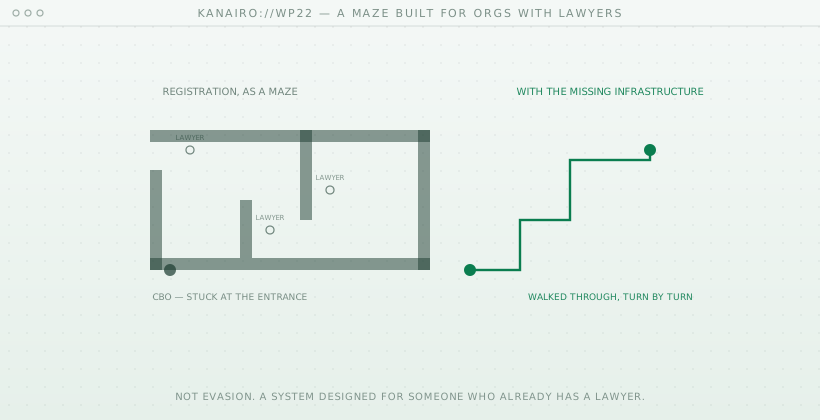
This paper argues that Kenya's Public Benefit Organizations Act registration gap is now primarily a capability gap rather than an integrity gap. The conventional account — that unregistered community-based organisations are avoiding scrutiny — fit Kenya's pre-2013 NGO Co-ordination Act, which was used at times as a tool of political control. It does not fit the PBO Act, 2013, a deliberately more enabling instrument whose requirements are nonetheless specific, enumerable, …
|
||||||
| WP21 | Personalized Is the New Glow the skincare industry sold "glow" as something you could buy off a shelf, the same product for everyone. This essay argues glow was always personalization wearing a different name… | AI Automation | ⌁ verified |
d465b3ddf73d
|
||
|
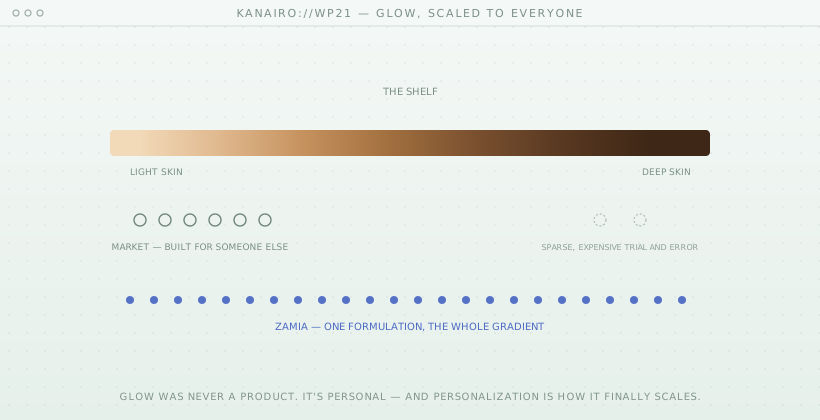
This paper argues that "glow" was always a description of personalized skin care, not a purchasable finish — and that melanin-rich skin has been structurally excluded from that personalization for decades, at real cost in money, time, and the skin itself. It is the earlier of two Flux papers on this subject; [[040-two-jobs-of-personalized|a later paper]] (WP41) grounds the clinical and regulatory case in the dermatology literature on skin-of-color underrepresentation and …
|
||||||
| WP20 | Accountability Is Not a Reason to Keep Humans in the Process most organisations assume a human has to sign off on routine, rule-based decisions for there to be real accountability. This paper argues that assumption mostly tracks the wrong t… | AI Automation | ⌁ verified |
1ba67d135fd3
|
||
|
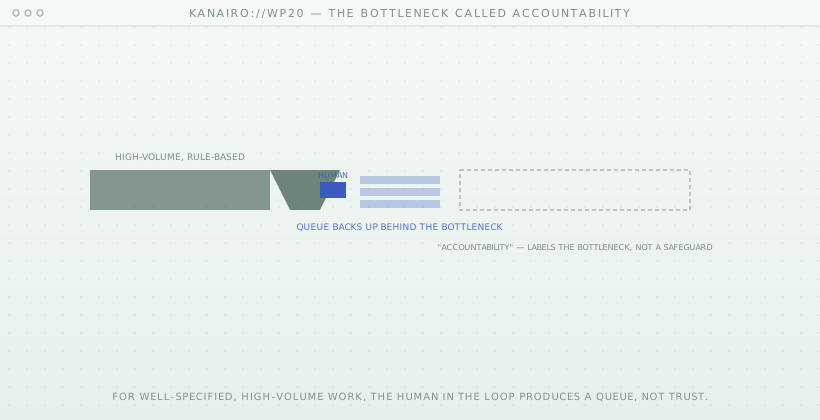
This paper argues that for well-specified, high-volume, rule-based processes, human involvement does not produce the accountability it is assumed to produce — it produces a bottleneck and, often, an undocumented point of failure that a well-specified automated system would not have. The pre-revision body carried an unfinished footnote with literal bracketed research instructions left in the published text; this revision treats that as a to-do list and completes it. New …
|
||||||
| WP19 | Your AI Strategy Is Digital Transformation With Better Branding most "AI transformation" strategies are really just digital transformation wearing a new label — technology making the same process faster, not asking whether the process should e… | AI Automation | ⌁ verified |
229728d49a70
|
||
|
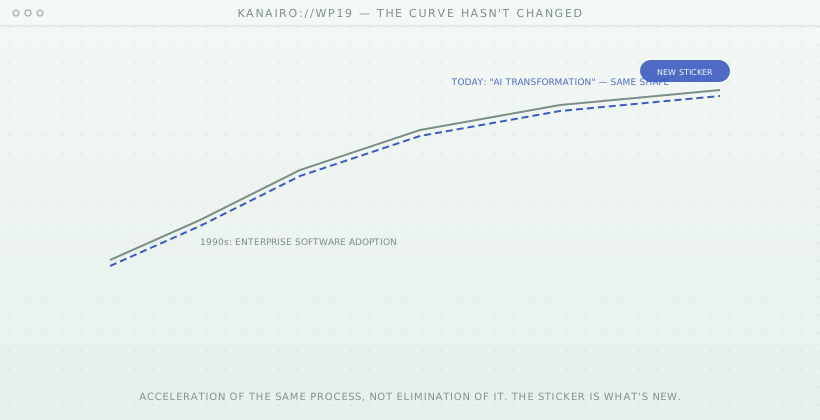
This paper argues that most organisational "AI transformation" strategies are digital transformation with updated branding: technology accelerating an existing process rather than eliminating it. The distinction is not new. Michael Hammer's 1990 Harvard Business Review article made the identical argument about an earlier technology wave, and this revision grounds it in his own case data, read directly: Ford's accounts payable department achieved a 75% headcount reduction by redesigning its process, …
|
||||||
| WP18 | The Expense Report Was Never About Expenses The procurement trust series the expense report looks like an accounting form, but it is really a trust mechanism — a way for an organisation that cannot watch every purchase to find out, after the fact, whet… | AI Automation | ⌁ verified |
0174f5b8b050
|
||
|
This paper argues that the corporate expense report is not primarily an accounting instrument but a trust mechanism — a monitoring-cost response, in Jensen and Meckling's 1976 sense, to the problem of delegating spending authority to employees whose judgment about appropriate spending is not identical to organisational policy. It argues that agentic payment infrastructure such as ProcureBee's virtual cards does not automate this mechanism but eliminates it, by moving policy …
|
||||||
| WP17 | Did It Do It For You? there is one test for any AI deployment. When the work was finished, did the AI do it, or did it help a person do it faster? Most of what is being called AI transformation is the … | AI Automation | ⌁ verified |
c9cc07f25b1a
|
||
|
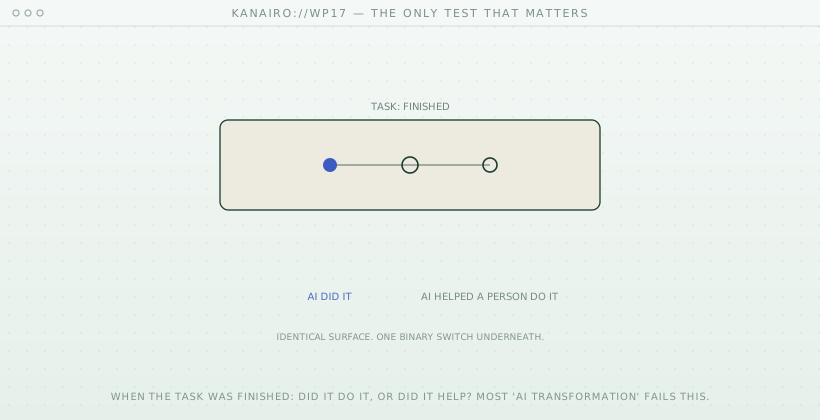
This paper argues that the central question for any AI deployment is binary: when the task was finished, did the AI do it, or did it help a person do it? "AI-assisted" work leaves the human as the agent and the AI as a faster tool; "AI-complete" work redesigns the process so a human is no longer required for individual instances, only for setting policy and handling exceptions. The paper …
|
||||||
| WP16 | Africa's Regulatory Failure Is Not a Law Problem The PBO compliance series Kenya replaced a bad law for non-profits with a good one, and registration barely moved. The lesson is that drafting a good law is only half the job. Somebody still has to build t… | Civic & Democratic Infrastructure | ⌁ verified |
7bea851d1b04
|
||
|
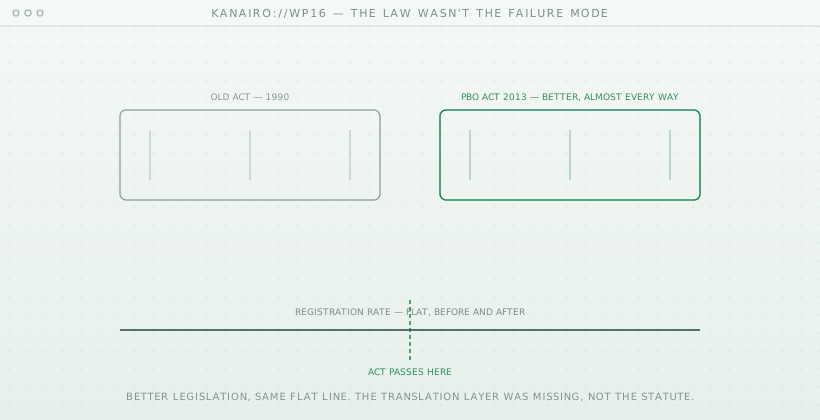
This paper argues that the gap between civil-society legislation's quality and its actual compliance rate — visible across East and West African reform waves, not only in Kenya — is best explained by the absence of a "translation layer": the tools, advisory services, and software that make a normative legal framework navigable for the organisations it governs, as distinct from the quality of the drafting itself. Kenya's 2013 PBO Act, …
|
||||||
| WP15 | Your Donor Is Now Your Regulator The PBO compliance series the pressure on Kenyan civil society to prove it is compliant used to come from the state. It now comes mostly from the donors who fund the work, through their own due-diligence c… | Civic & Democratic Infrastructure | ⌁ verified |
272fd3219528
|
||
|
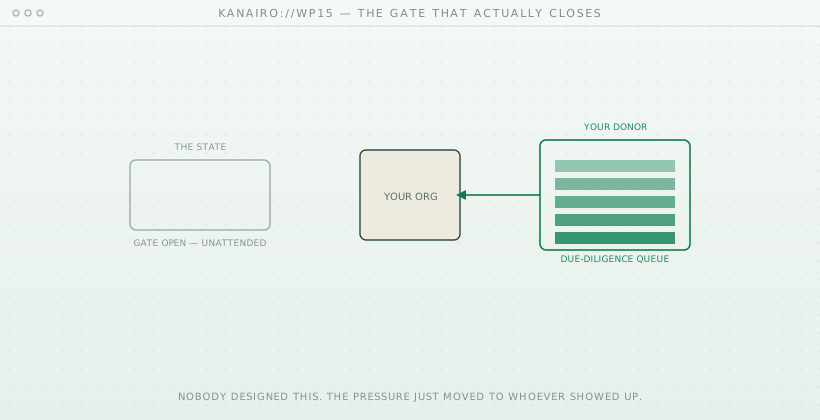
This paper argues that international donors' due-diligence requirements have, without central coordination, come to function as a compliance regime for Kenyan civil society more consistent than anything the state has applied — and that the organisations least able to meet it tend to be the ones doing the most essential ground-level work. This revision corrects two factual errors the prior draft had flagged but not resolved: the EU citation (superseded …
|
||||||
| WP14 | What a Language Model Finds When It Reads Your Constitution The PBO compliance series asking AI to interpret the law is hard and contested. Asking it to check a document against a fixed list — does this constitution contain the clauses the Act requires? — is neithe… | Civic & Democratic Infrastructure | ⌁ verified |
73f2f85f6b92
|
||
|
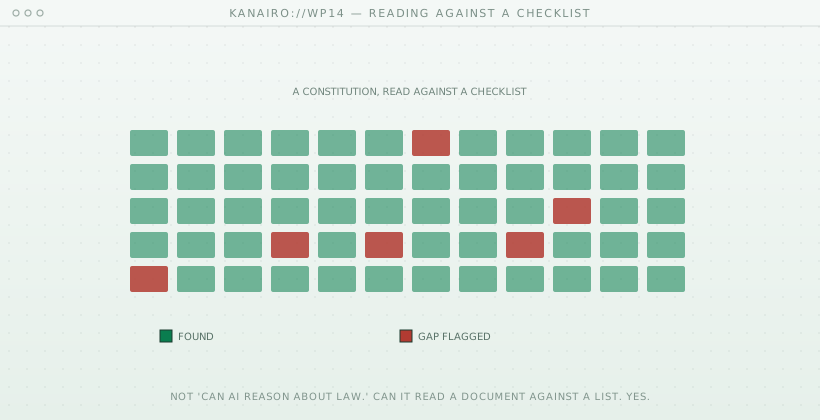
This paper distinguishes two categories of "AI and the law" work that the public discourse routinely conflates: open-ended legal reasoning, where large language models are impressive but unreliable without expert oversight, and document-grounded compliance checking — does this specific document contain language satisfying this specific, pre-specified requirement — where the published evidence supports much higher confidence. It grounds that distinction in a mechanism rather than an assertion: a 2024 study …
|
||||||
| WP13 | Kenya's PBO Act Is Finally in Force After a Decade. Most Organisations Still Cannot Comply. The PBO compliance series the law governing Kenyan non-profits was passed in 2013 and only came into force more than a decade later. Its requirements are not unreasonable on their face, but meeting them ta… | Civic & Democratic Infrastructure | ⌁ verified |
0638620d5f78
|
||
|
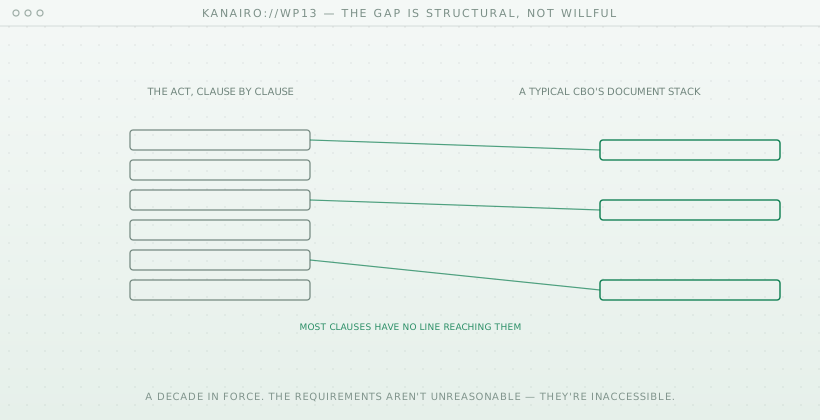
Kenya's PBO Act came into force on 14 May 2024, after sitting unimplemented for over a decade, yet most eligible organisations still have not transitioned under it. This paper argues the dominant reason is not fees, malice, or disengagement, but a navigability gap: Section 8 requires a constitution that maps clause by clause onto specific provisions -- a conflict-of-interest clause, precise meeting-frequency and quorum rules, a compliant dissolution clause -- …
|
||||||
| WP12 | The Agentic Buyer and the End of Dark Patterns The procurement trust series the pricing page you see on a SaaS website is designed to work on human psychology — anchoring, social proof, urgency, hidden cancellation. An AI shopping agent doesn't see that d… | AI Automation | ⌁ verified |
dad1afc8c3e0
|
||
|
This paper argues that SaaS pricing pages are built to manipulate human psychology — anchoring, decoy pricing, social proof, defaults, cancellation friction — and that AI procurement agents largely do not process pages the way the visual and social channels these patterns exploit require, creating pressure toward pricing clarity. The original essay claimed agents "have no psychological vulnerabilities." This revision corrects that rather than carrying it forward: a peer-reviewed 2025 …
|
||||||
| WP11 | The Corporate Card Was Never the Solution The procurement trust series companies still pass one card number around the office, because there has never been a good way to let somebody buy one specific thing. Every instrument invented since the 1950s h… | AI Automation | ⌁ verified |
854822cd535f
|
||
|
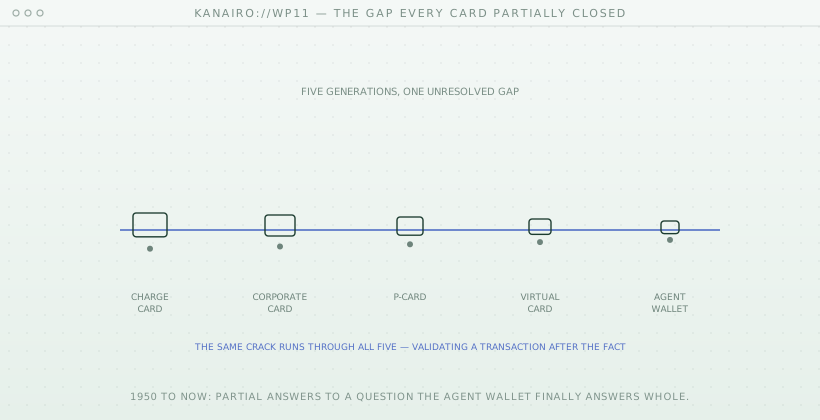
Every corporate payment instrument since 1950 -- the charge card, the credit card, the purchase card, the programmable virtual card -- has narrowed the gap between when spending authority is granted and when a specific transaction is validated against it, without closing it. This paper traces that lineage, correcting its own prior account along the way: purchase cards are usually filed under "2000s procurement" but U.S. federal adoption actually began …
|
||||||
| WP10 | Your Knowledge Gaps Are the Most Intimate Data You Have where you went and what you bought are already treated as sensitive data. What you did not understand — the words you looked up, the sentence where your comprehension ran out — is… | AI Automation | ⌁ verified |
e18fd9157b7d
|
||
|
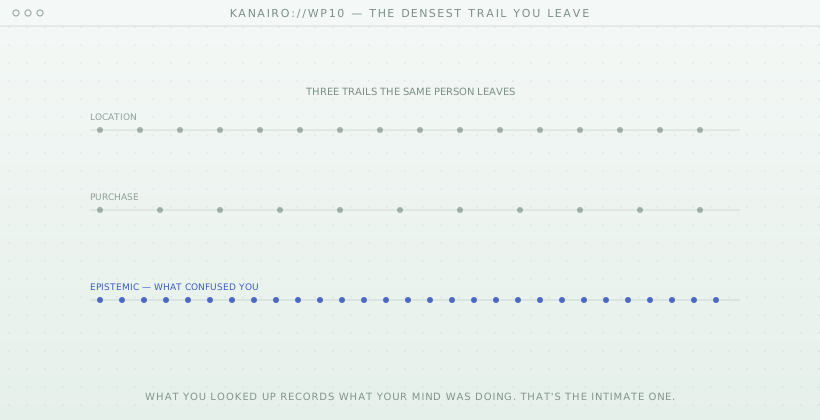
This paper argues that epistemic data — the record of what a person looked up, what confused them, and where their understanding ran out — is a more intimate category of behavioral data than location or purchase history, because it maps cognitive and professional state rather than external action, and that AI reading/comprehension tools are being built directly on top of it before any protective default has been set. It …
|
||||||
| WP09 | The Web Was Built for Navigation, Not Comprehension every primitive the web gave us — the link, the page, the tab — is a way of going somewhere else. Understanding the thing in front of you is the one task that going somewhere else… | AI Automation | ⌁ verified |
24db01675a97
|
||
|
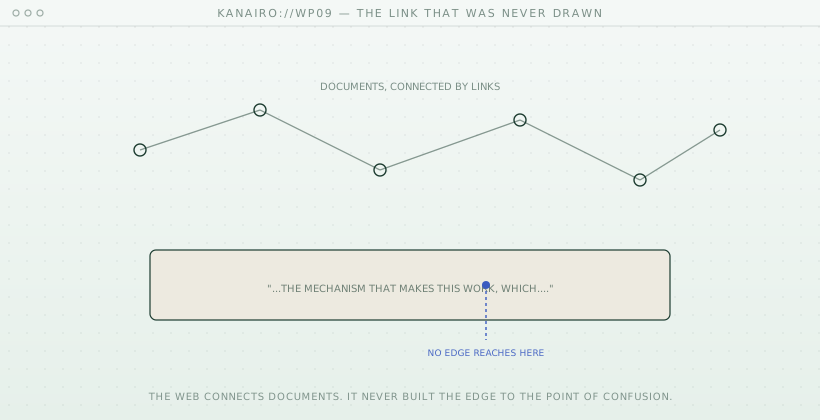
The web's core primitives -- the link, the page, the tab -- were built to solve document connectivity, not in-document comprehension, and this paper argues that specific architectural mismatch is what makes stopping to look up an unfamiliar term so costly to a reader's progress. This revision makes a significant correction, stated plainly: the previous draft attributed a widely circulated "23 minutes to refocus" statistic to Gloria Mark's research. Reading …
|
||||||
| WP08 | Procuring the Unspecifiable: Why Institutional Software Procurement Is Broken in Kenya Kenyan public bodies buy software the way they buy office furniture — write a specification, take the lowest compliant bid, set a delivery date. Software cannot be specified that … | Civic & Democratic Infrastructure | ⌁ verified |
fefd46ab7519
|
||
|
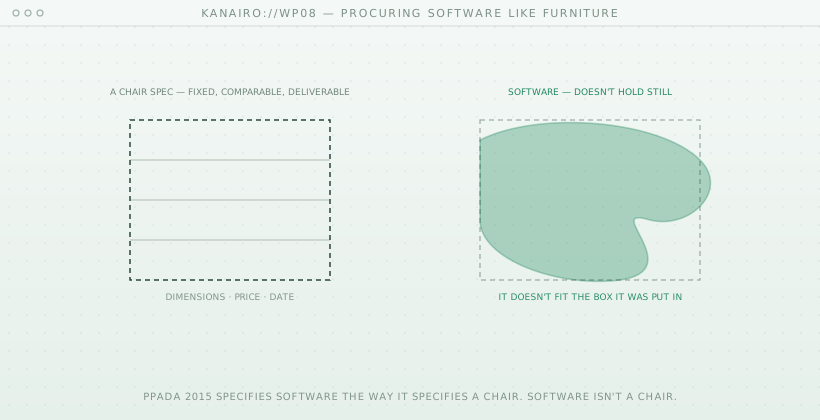
Kenya's Public Procurement and Asset Disposal Act treats software as a commodity that can be fully specified in advance, compared by price, and delivered on a fixed date. This paper argues that this assumption is mismatched to how software is actually built, producing a predictable cycle of failed systems, vendor capture, and fraud-enabling infrastructure. It argues for reconceiving software as a distinct category of public acquisition with iterative delivery and …
|
||||||
| WP07 | The Last Mile of Care: What Kenya's Community Health Workers Are Missing Kenya has committed to a community health promoter for roughly every twenty households, visiting homes regularly and recording what they find — on paper in many places, increasing… | Community Health | ⌁ verified |
cb368a431cd1
|
||
|
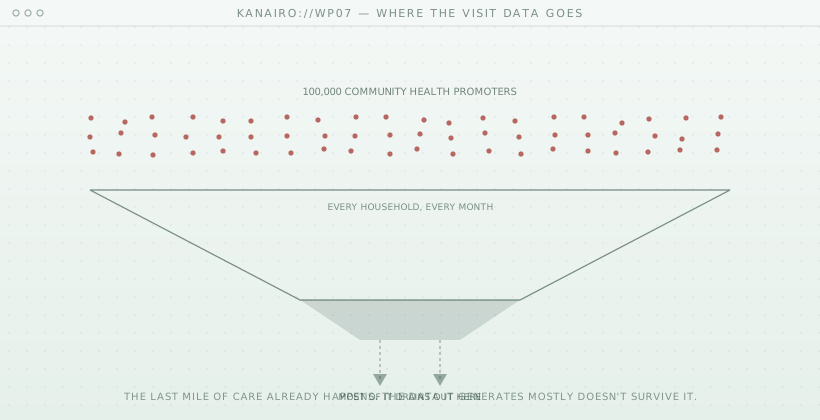
This paper re-examines Kenya's community health data pipeline against sources researched fresh rather than carried over, and corrects two figures the prior body stated as fact: the household-to-promoter ratio is 20 households (about 100 people) per Community Health Promoter, not 100 households, and the supervisory ratio is 20 CHPs per Community Health Assistant, not twelve to fifteen — both now verified directly against the Ministry of Health's own 2024 clinical …
|
||||||
| WP06 | The Offline-First Problem: Why Most Institutional Software Fails in the Field most institutional software assumes a working internet connection. In the field there often is not one, so the app stops, the team falls back to paper, and the data never arrives … | Water & Sanitation | ⌁ verified |
6356ecbfdb31
|
||
|
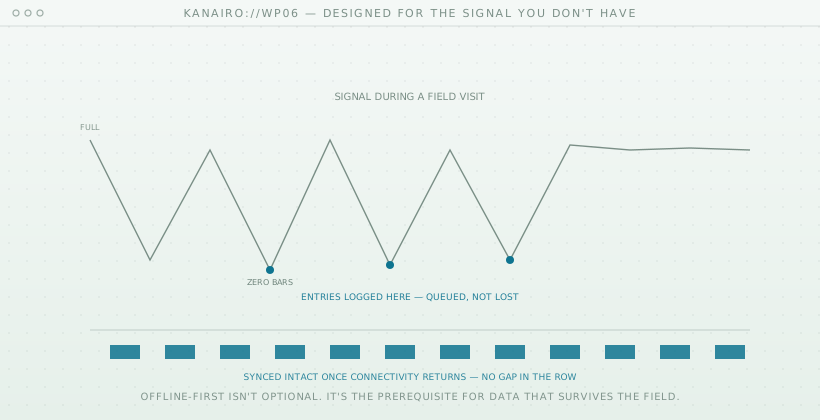
Most institutional software deployed in African field settings fails for a shared, architectural reason: it assumes continuous connectivity that does not exist where it is meant to operate. This revision adds a scope section distinguishing the paper's architecture argument from a measured outcome; grounds "offline-first" in the published local-first software literature (Kleppmann et al., Onward! 2019) and the well-established CAP/eventual-consistency trade-off (Vogels, CACM 2009) — while being explicit that both …
|
||||||
| WP05 | Democracy Is Infrastructure a Kenyan MP's constituency office runs on WhatsApp groups, a shared spreadsheet, and the personal phones of whoever has been there longest. Whatever a citizen can actually get fro… | Civic & Democratic Infrastructure | ⌁ verified |
0680cb758848
|
||
|
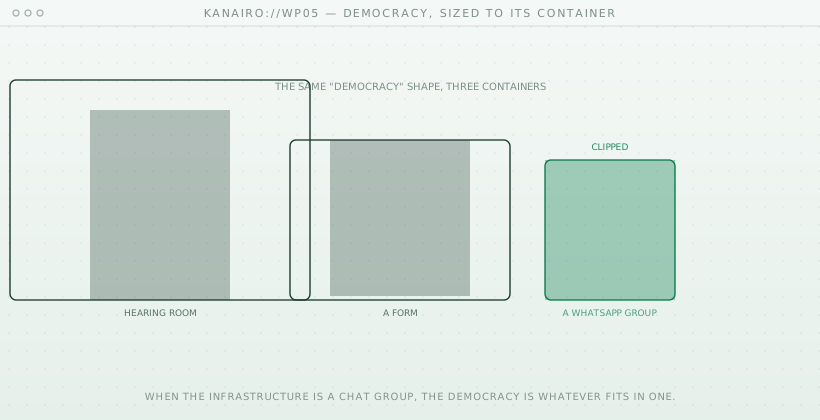
A Kenyan constituency office is functionally a casework CRM, grants administration platform, and small government treasury run on WhatsApp groups and an inconsistently updated spreadsheet. This revision adds a scope section distinguishing the paper's repeated observation of one office from a sampled finding; grounds the "democracy is infrastructure" framing in a real, if US-centric, political-science framework (Rahman & Gilman, New America, 2019) rather than asserting it as this paper's own …
|
||||||
| WP04 | Why Africa Needs Stablecoin Rails Before It Needs a Digital Currency moving money in and out of Africa is expensive, and the official answer — a digital currency issued by a central bank — is years of regulation away. Stablecoins are digital tokens… | Open Finance & Inclusion | ⌁ verified |
f3a6fd966338
|
||
|
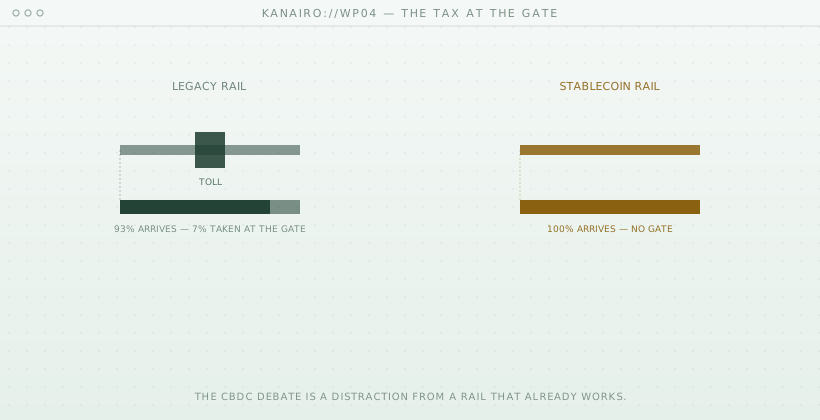
This paper argues that stablecoin-native payment rails, not central bank digital currencies, are the more immediate and tractable fix for African institutional finance — utilities, cooperatives, and community organisations whose cross-border settlement, treasury, and reporting needs are poorly served by both legacy correspondent banking and retail-focused CBDCs. This revision adds a scope section distinguishing the paper's architectural argument from a measured outcome; re-verifies the World Bank's remittance-cost data (8.78% Sub-Saharan …
|
||||||
| WP03 | What Happens When Institutions Can Finally See Themselves most African public institutions cannot answer basic questions about what they did yesterday. Not because anyone is hiding anything, but because nobody built the instruments. This… | Civic & Democratic Infrastructure | ⌁ verified |
15a422730cd8
|
||
|
This paper revisits the claim that African public institutions change in three specific ways once they gain operational visibility — problems become legible, accountability becomes possible, and learning becomes structural — and separates what is actually measured from what is argued by analogy. It keeps the original AccessWASH deployment table but states plainly, for the first time, that the table is Flux's own unaudited account of its own product, not …
|
||||||
| WP02 | Africa's Institutions Don't Have a Funding Problem when people ask why Africa's public services underperform, they usually reach for corruption, underfunding, or weak institutions. Those are real, but this paper argues for a diffe… | Water & Sanitation | ⌁ verified |
49738763903f
|
||
|
This paper revisits the claim that Africa's public institutions fail primarily from missing software tools rather than corruption or underfunding, and is more careful than the original body about what that claim can and cannot carry. It replaces an unverifiable "~45% average, 21 counties exceeding 50%" non-revenue-water figure with Kenya's water regulator's current sector report (44% national average, 25% benchmark, a 28%-75% county range), and replaces an unverifiable "10 to …
|
||||||
| WP01 | The Missing Layer: Why Africa's Institutions Operate Blind this paper argues that the single biggest thing standing between Africa's public institutions and better performance is not corruption, not a lack of money, and not a lack of poli… | — | ⌁ verified |
9af84b9773ad
|
||
|
This is the founding essay of the Flux working-paper corpus, and this revision is deliberately conservative about its own core claim: Africa's public institutions fail not primarily from corruption, underfunding, or missing political will, but from the absence of an operational data layer that lets an institution observe what it is actually doing in real time. The closing statement of that thesis is unchanged. What changes is the evidence underneath …
|
||||||


Nothing in the registry matches that.